References
FRIDA Computing Center

FRIDA: Blackwell on the Roof of the University of Ljubljana

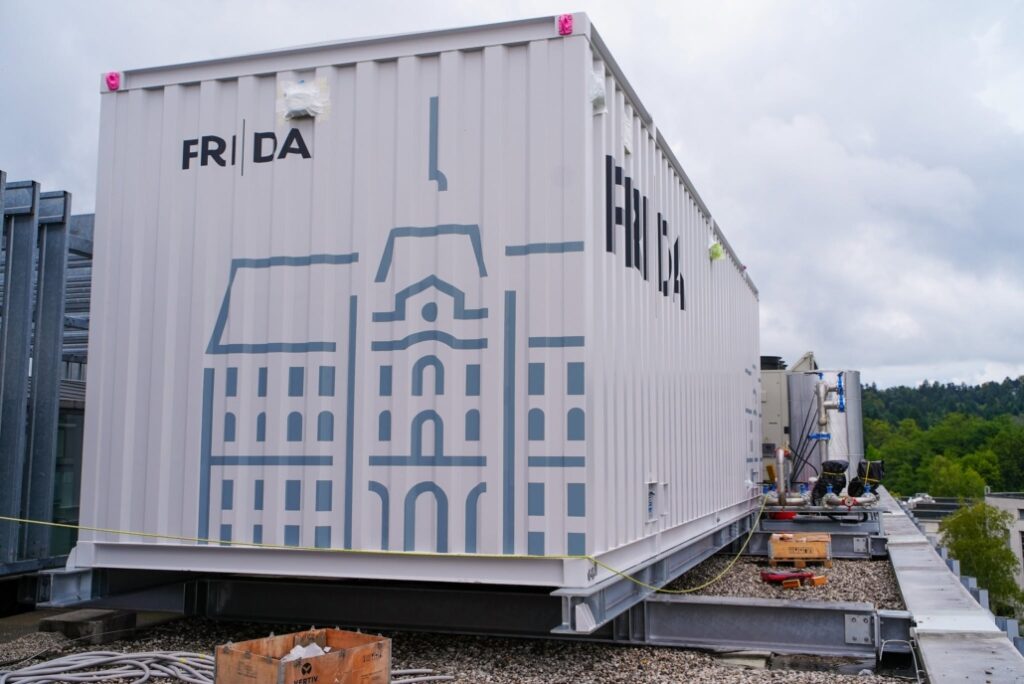
Something unparalleled in the academic world of Central and Eastern Europe has been built on the roof of the Faculty of Computer and Information Science at the University of Ljubljana (UL FRI). 

The modular container-based supercomputing center FRIDA has been established here, bringing together GPU accelerators from several different generations under one roof. M Computers has supplied this unique infrastructure with its absolute technological pinnacle: NVIDIA DGX B200 and DGX B300 systems featuring the revolutionary Blackwell architecture.

FRIDA Computing Center
// An Engineering Challenge

The Computing Center on the Faculty Roof

The University of Ljubljana is Slovenia’s oldest and largest university, and its Faculty of Computer and Information Science (UL FRI) builds on a tradition of artificial intelligence research spanning more than forty years. As the very first academic institution in the region, it now boasts the combined power of eight NVIDIA DGX B200 and B300 systems. This means that research teams, ambitious students, and commercial partners from industry have the latest computing power right at their fingertips.

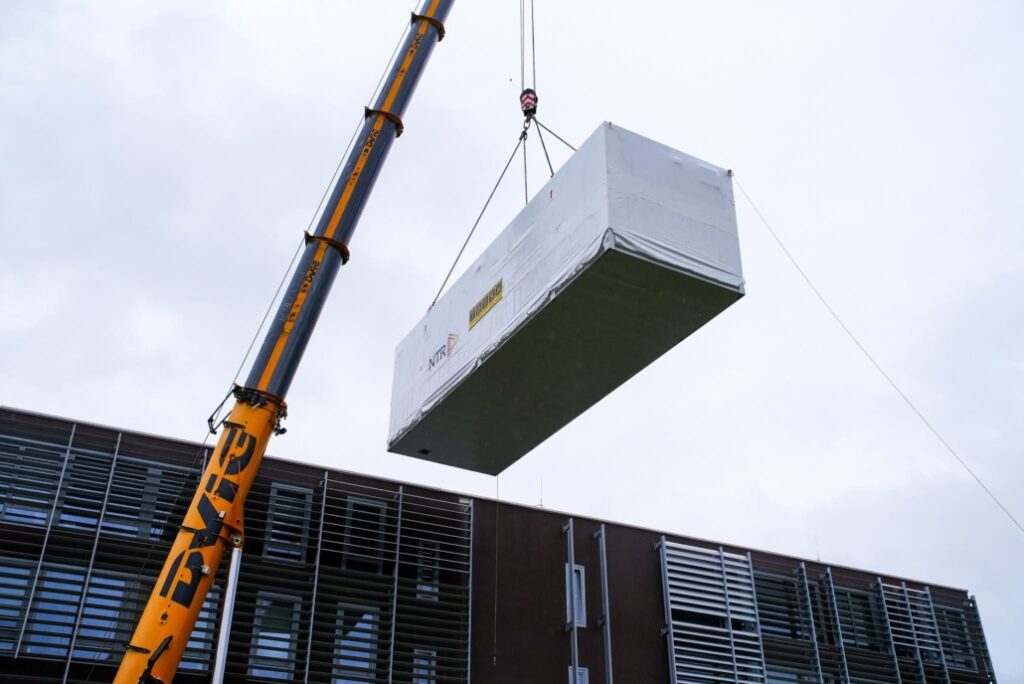
FRIDA is a prime example of how extreme performance meets spatial minimalism. The supercomputing center was built in a modular container data center located directly on the roof of the faculty building. The entire massive technology unit and its sensitive systems had to be hoisted onto the roof by a heavy-duty crane.

Packing extreme computing power, a stable power supply, and a robust network into a compact container required uncompromising engineering. Modern AI servers generate a massive thermal load. The container therefore relies on advanced hybrid cooling. This is the only way to maintain a stable temperature over the long term in a limited space for systems with such high power density.

FRIDA Computing Center
// hardware

NVIDIA Blackwell: Breathtaking Performance

The team at M Computers has equipped FRIDA with the very best the world of accelerated computing has to offer. The university currently has four NVIDIA DGX B200 systems and four DGX B300 systems at its disposal, connected by an ultra-high-bandwidth network with speeds of up to 800 Gb/s.

A single DGX B200 node offers 1,440 GB of total GPU memory, while the more advanced DGX B300, featuring the Blackwell Ultra architecture, provides a massive 2,304 GB of memory. This top-of-the-line configuration generates such staggering power that FRIDA can perform more calculations in a single second than the entire population of Slovenia could in 10,000 years if every resident were to calculate on a calculator continuously, 24 hours a day.

“Our task was to deliver the core computing component of the FRIDA infrastructure, based on the state-of-the-art NVIDIA DGX B200 and B300 systems. Thanks to the combination of both platforms, the university now has a flexible environment for various types of AI and scientific tasks that require exceptional memory capacity and throughput,” explains Kamila Jeřábková, NVIDIA product manager at M Computers.

FRIDA Computing Center
// conclusion

A Driver of Innovation at the University

FRIDA is fundamentally changing the game. It reduces the training time for complex AI models from weeks to just hours or days. And this is by no means a closed academic experiment. The supercomputer will serve as a key development platform for Slovenia’s large language model GaMS, for testing advanced autonomous AI agents and machine vision, as well as for commercial companies and startups, which can use it to prototype solutions with a massive competitive advantage.

In this case, FRIDA demonstrates that cutting-edge European AI infrastructure doesn’t have to be built only in large data centers. It can just as easily be located on the roof of a university and drive technological innovation across the entire region from there.

Logo M Computers | NVIDIA

Author

Adam Bendík